
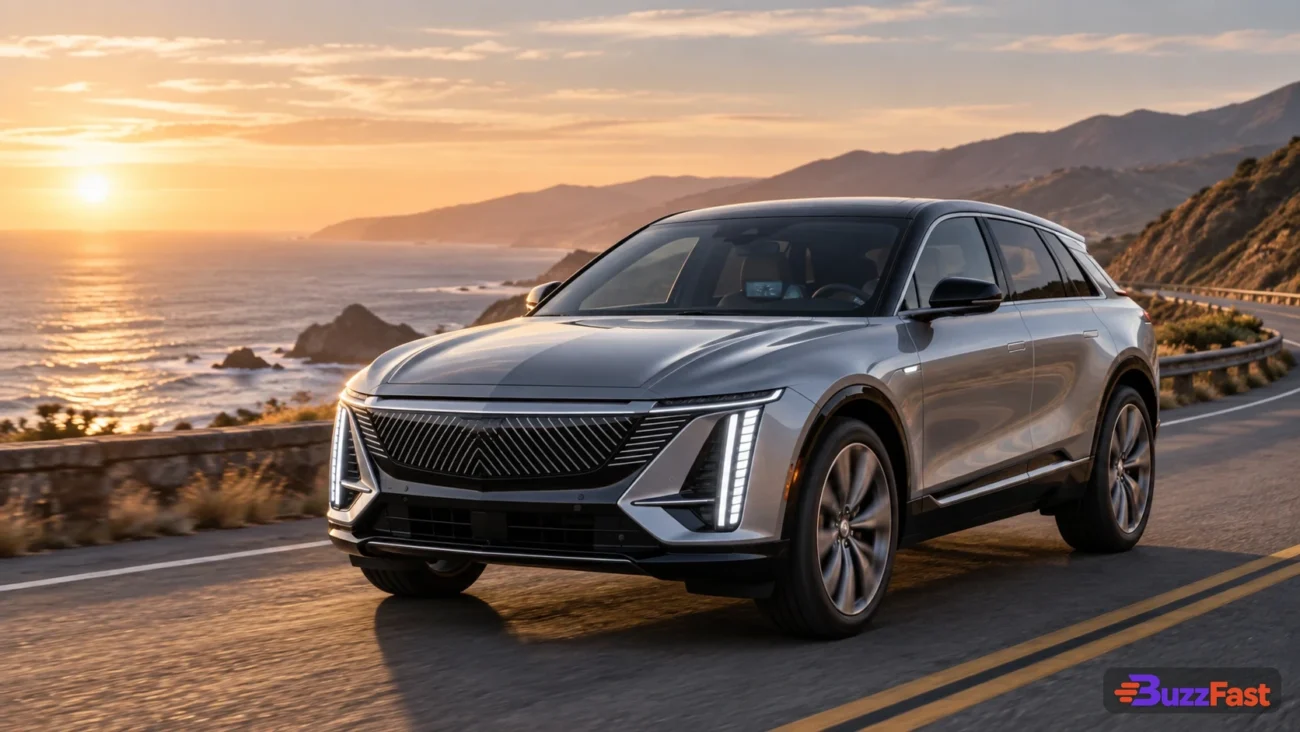
Yes, the Cadillac LYRIQ’s driving modes can affect how quickly the vehicle uses energy and what range the dashboard predicts, but they do not change the battery’s physical capacity or give the car a different official EPA range for each mode.
Tour, Sport, Snow/Ice and My Mode change aspects of the LYRIQ’s response, such as accelerator tuning, steering and traction behavior. Cadillac also says performance modes can affect the vehicle’s estimated remaining range. What Cadillac does not publish is a fixed rule such as “Sport cuts range by 15%.” There is no verified universal Tour-versus-Sport mileage penalty.
What changes when you select a LYRIQ drive mode?
Cadillac’s 2025 LYRIQ Owner Manual documents four modes for the regular LYRIQ: Tour, Sport, Snow/Ice and My Mode. Exact availability and the systems affected can vary by trim, equipment and model year.
Tour
Tour is the everyday setting. Cadillac describes it as suitable for normal city and highway driving, balancing comfort and handling.
That makes it a sensible baseline for drivers concerned about efficiency, but it should not be treated as a guaranteed maximum-range mode. Speed, acceleration, temperature, terrain and climate-control use can still have a larger effect on energy consumption.
Sport
Sport changes the LYRIQ’s character more noticeably. In the 2025 manual, it alters pedal tuning and steering effort and can also affect EV sound enhancement, adaptive cruise behavior and suspension tuning where equipped.
The important point for range is the accelerator response. A sharper response can make stronger acceleration easier to call up, and stronger acceleration requires more energy.
That does not mean simply selecting Sport immediately consumes a fixed extra percentage of the battery. A driver using gentle inputs in Sport may see a much smaller difference than someone repeatedly using the extra responsiveness.
Snow/Ice
Snow/Ice is a traction setting, not an efficiency setting. Cadillac says it changes pedal tuning to help the vehicle maintain traction on slippery surfaces and can also alter eAWD and steering behavior.
A LYRIQ may show lower range during winter use, but cold temperatures, cabin heating, road conditions and increased resistance can all contribute. It would be misleading to attribute a winter range drop to Snow/Ice mode alone.
My Mode
My Mode lets the driver personalize several responses. In Cadillac’s documented 2025 configuration, available settings include acceleration feel, brake feel, steering, suspension and motor sound, depending on equipment.
Because My Mode is configurable, there is no single battery-usage figure for it. A calmer accelerator setup may encourage smoother driving, while a more aggressive setup can lead to higher consumption.
Does Sport Mode use more battery?
It can, but there is no reliable fixed percentage.
Cadillac says acceleration rate is one of the factors that affects LYRIQ range. Sport changes pedal response and is designed to provide a more performance-oriented feel, so frequent hard acceleration in Sport can increase electricity consumption.
The distinction matters because several websites publish very specific claims that Sport reduces range by 8%, 15%, 16% or even 20%. Those figures are not published by Cadillac, and no controlled same-car, same-route LYRIQ test has established a universal penalty.
So a more accurate way to put it is: Sport can use more energy when its sharper response leads to harder or more frequent acceleration, but the mode itself does not impose a known fixed range loss.
Why can the dashboard range change after using a performance mode?
The miles remaining on the LYRIQ’s display are an estimate, not a direct measurement of how far the battery must travel before reaching zero.
Cadillac says that estimate takes recent driving habits, vehicle conditions and HVAC use into account. The manual specifically notes that aggressive driving and performance modes can affect the range estimate.
That means a lower number on the display after spirited driving does not mean the battery suddenly lost physical capacity. The car is adjusting its prediction based on recent energy use.
This is one reason owners should keep four different figures separate:
- Battery capacity: how much energy the battery is rated to hold.
- State of charge: how full the battery currently is.
- EPA-estimated range: the standardized range figure assigned to a vehicle configuration.
- Dashboard range estimate: the LYRIQ’s changing prediction based partly on recent use.
The current LYRIQ has a 102-kWh battery, regardless of mode
As of September 25, 2026, Cadillac’s 2027 LYRIQ specifications list a 102-kWh battery capacity for the regular LYRIQ.
Cadillac lists EPA-estimated range by vehicle configuration, not by selectable drive mode:
| 2027 LYRIQ configuration | EPA-estimated range |
|---|---|
| Single-motor RWD | 326 miles |
| AWD with standard 11.5-kW charging hardware | 319 miles |
| AWD with available 19.2-kW charging configuration | 303 miles |
| LYRIQ-V | 285 miles |
The LYRIQ-V should not be used to estimate what Sport Mode “costs” on a regular LYRIQ. It is a different performance configuration with its own motors, tuning and official range figure.
Likewise, switching a regular LYRIQ from Tour to Sport does not turn its 102-kWh battery into a smaller battery. The amount of energy available is governed by the battery and its state of charge; the mode changes how the vehicle responds while using that energy.
One-Pedal Driving is separate from the drive modes
One-Pedal Driving and regenerative braking are often mixed into discussions about LYRIQ drive modes, but Cadillac treats them as separate controls.
Regenerative braking uses the electric motors to slow the vehicle while recovering some energy that would otherwise be lost during deceleration. Cadillac says One-Pedal Driving can recover energy while coasting and braking, and the 2025 manual says it can recover more energy in those situations than ordinary D operation.
That still does not justify claims that One-Pedal Driving adds a fixed 5% or 10% to every trip. Its benefit depends heavily on how often the vehicle needs to slow down.
Cadillac’s One-Pedal Driving and Regen On Demand guidance also notes practical limits. Regenerative braking can be reduced when the battery is near full or at certain temperatures, and Cadillac advises against using One-Pedal Driving or Regen On Demand on slippery roads.
What affects LYRIQ range more than the mode label?
Drive mode is only one variable. Cadillac also identifies acceleration rate, travel speed, tire pressure, maintenance and ambient weather as factors affecting range.
HVAC use matters because cabin heating and cooling draw electrical energy. Higher speeds also increase energy demand, while climbing grades requires more energy than driving on level ground.
An independent 2024 AWD LYRIQ road test by Capital One Auto Navigator illustrates the broader point. The reviewer recorded 41 kWh per 100 miles during self-described “lead-footed” combined driving, compared with the vehicle’s then-EPA consumption figure of 38 kWh per 100 miles. That test did not isolate Sport Mode, so it cannot be used as a Sport-versus-Tour comparison, but it does show how driving behavior can move consumption away from standardized figures.
For owners trying to understand their own vehicle, comparing energy use over the same commute in similar weather and traffic is more informative than relying on a generic “Sport costs X percent” claim.
Is Tour Mode the same as the EPA test mode?
That has not been established for the LYRIQ.
A common claim online is that the EPA range figure is simply the car’s Tour-mode range. Another is that the EPA does not test drive modes at all. Neither should be stated that way.
The EPA has specific guidance for battery-electric vehicles with multiple selectable modes. Under its BEV drive-mode testing guidance, vehicles with multiple “latching” modes and no single default mode may require testing of the best- and worst-case modes and averaging the results, or testing the worst-case mode.
The exact LYRIQ certification mode or combination used for its current EPA label has not been publicly established in the material available here. So there is no sound basis for saying the official figure belongs exclusively to Tour.
So which LYRIQ mode is best for range?
Tour is the most straightforward everyday choice for a driver who wants smooth, predictable response and is trying to avoid unnecessary hard acceleration. But Cadillac does not guarantee that Tour will always produce the longest real-world range in every situation.
Sport can consume more energy when the sharper response is used aggressively. Snow/Ice should be selected for traction when conditions call for it rather than avoided to chase a small theoretical efficiency difference. My Mode depends on the settings chosen.
The key point is simpler than many mode-by-mode range tables suggest: the LYRIQ keeps the same battery, while drive modes change how the vehicle responds and can influence how efficiently that stored energy is used. Cadillac also confirms that performance modes can affect the displayed range estimate, but there is no verified universal mileage or percentage penalty for switching from Tour to Sport.
